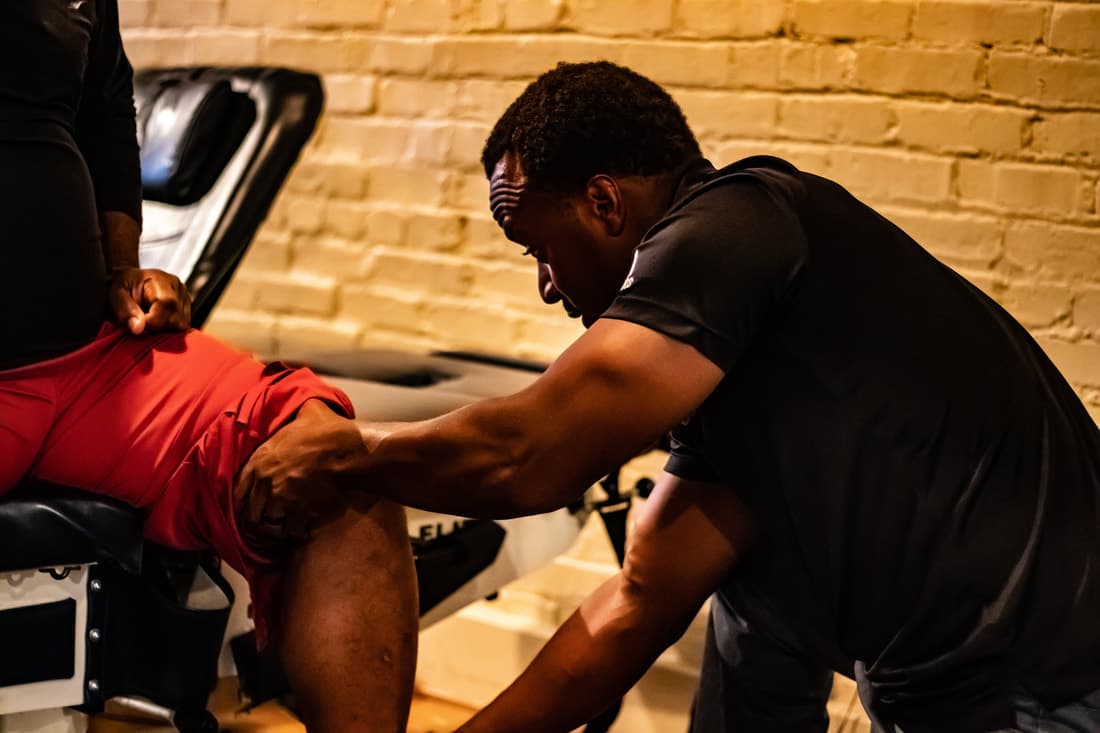
You have heard the word “adjustment,” and you may have felt the release of tension during one. But what actually happens during that brief, controlled movement, and what does the research say about why some people feel better afterward? Understanding the science can make an adjustment feel less mysterious and help you set realistic expectations.
What Is a Spinal Adjustment?
A spinal adjustment, also called spinal manipulation, is a quick, controlled movement applied by hand to a joint that is stiff or not moving well. The practitioner positions you, takes the joint to the end of its comfortable range, and applies a short, precise thrust. A related approach, mobilization, uses slower and gentler movements without a thrust.
The goal is not simply to “crack” your back. It is to improve how the joint moves, ease pain, and make it easier for the surrounding muscles to do their work without guarding or strain.
The Neurological Side: How Adjustments May Affect Pain
Your spine protects the spinal cord and the nerves that branch off it. Joints, muscles, and ligaments are full of sensory receptors that constantly report position and movement to your nervous system. Researchers think much of the effect of an adjustment comes through these pathways:
- Pain modulation: the sensory input from an adjustment may temporarily dampen how strongly pain signals are processed, a little like the way rubbing a bumped elbow makes it feel better.
- Muscle tone: some studies report short-term reductions in muscle guarding around the treated area, which may make movement more comfortable.
- Body awareness: adjustments may influence proprioception, your sense of where your body is in space. Research in this area is still developing.
Some researchers are also studying whether spinal manipulation affects the autonomic nervous system, which regulates stress responses. That work is early, and the findings so far are not strong enough to support broad health claims.
The Mechanical Side: Restoring Motion
When a joint becomes stiff, whether from injury, sustained postures, repetitive strain, or inflammation, the body compensates. Nearby muscles tighten, other joints take on extra load, and movement can become less efficient and more uncomfortable.
- Joint motion: moving a stiff joint through its range can improve how freely it moves, at least in the short term, which creates a window for exercise and stretching to do their work.
- The audible pop: the sound you may hear comes from gas forming a bubble in the fluid that lubricates the joint, a process called cavitation. It is harmless, and it is not bones moving back into place. Read more about what causes the popping sound.
- Range of motion: better joint motion can reduce strain on the surrounding muscles and make daily movements easier.
What Does the Research Say?
The evidence for spinal manipulation is strongest for some musculoskeletal problems, and limited or absent for others:
- Low back pain: clinical guidelines, including the American College of Physicians guideline on low back pain, list spinal manipulation among the non-drug options clinicians and patients may choose first, alongside approaches such as heat and exercise. See lower back pain.
- Neck pain: research supports manipulation and mobilization for some people with mechanical neck pain, with the best results generally seen when they are combined with exercise. See neck pain.
- Headaches: there is some evidence that manual therapy can help cervicogenic headaches, which start in the neck. Evidence for tension-type headaches and migraines is more mixed. See headaches and migraines.
- Other claims: claims that adjustments treat internal organ conditions or boost immunity are not supported by good evidence.
Who Might Benefit from Spinal Adjustments?
Adjustments may be worth considering for:
- People with back or neck pain
- People with headaches that seem to start in the neck
- Athletes managing stiffness alongside their training (see sports injury care)
- Office workers with postural strain
Adjustments are not right for everyone. Fractures, severe osteoporosis, certain inflammatory or vascular conditions, and signs of significant nerve compression all need careful screening, and may call for a gentler approach, a different treatment, or a referral. A thorough history and exam come first.
What to Expect During an Adjustment
- Assessment: your chiropractor examines your spine, looks for areas of restriction, and explains the plan before starting.
- Positioning: you are positioned comfortably, lying face down, on your side, or seated, depending on the area being treated.
- The adjustment: a quick, controlled movement is applied to the targeted joint. You may hear a pop. That is normal, and it is fine if you do not.
- Afterward: some people notice easier movement right away. Mild soreness, similar to what you feel after a new workout, can happen and is usually short-lived.
For a step-by-step walkthrough, read what to expect during your first chiropractic visit.
Moving Forward with Confidence
Spinal adjustments are a well-studied, hands-on treatment for certain back and neck problems. They are not a cure-all, but for the right person, combined with exercise and good daily habits, they can help restore comfortable movement.
At KC Wellness and Physiotherapy in Kansas City, Dr. Kowin Casey, DC, a chiropractic physician trained in a range of chiropractic adjusting techniques, provides chiropractic and spinal corrective care, which may be combined with physiotherapy and rehabilitation exercises.
If you are curious whether adjustments are a good fit for you, call our office at (913) 424-2410 or request an appointment online, and our office will call you to confirm a time.